
Disneyland's best-kept secrets revealed — Walt's apartment, hidden Mickeys, Easter eggs, architectural tricks, and the details only fanatics ever notice.
Save on Disneyland tickets
Compare prices across Undercover Tourist, Klook, and GetYourGuide
Introduction
I have been walking through those gates my entire life. Born and raised in Anaheim, Disneyland was never a once-in-a-lifetime trip for me — it was Tuesday. And what decades of repeat visits teaches you is this: most guests experience about 20 percent of what Disneyland actually contains.
The rides are the obvious 20 percent. The food, the characters, the parades — all obvious. What lives in the other 80 percent are the secrets. The details Walt insisted on that nobody was ever supposed to notice consciously. The Easter eggs Imagineers hid because they could. The historic artifacts sitting in plain sight that millions of guests walk past without any idea what they are looking at.
This is the guide I give people who have been to Disneyland before and want to see it differently. Some of these secrets require nothing more than looking up. Some require knowing exactly where to look. A few require a phone call and a reservation. All of them will change how you experience the park.
I have organized these into categories — architectural secrets, Walt Disney history, hidden Mickeys, Easter eggs by land, cast member secrets, and the secret spaces most guests never know exist. Work through as many as you can on your next visit.
Part 1 — Walt Disney's Personal Touches
The Lamp in the Fire Station Window
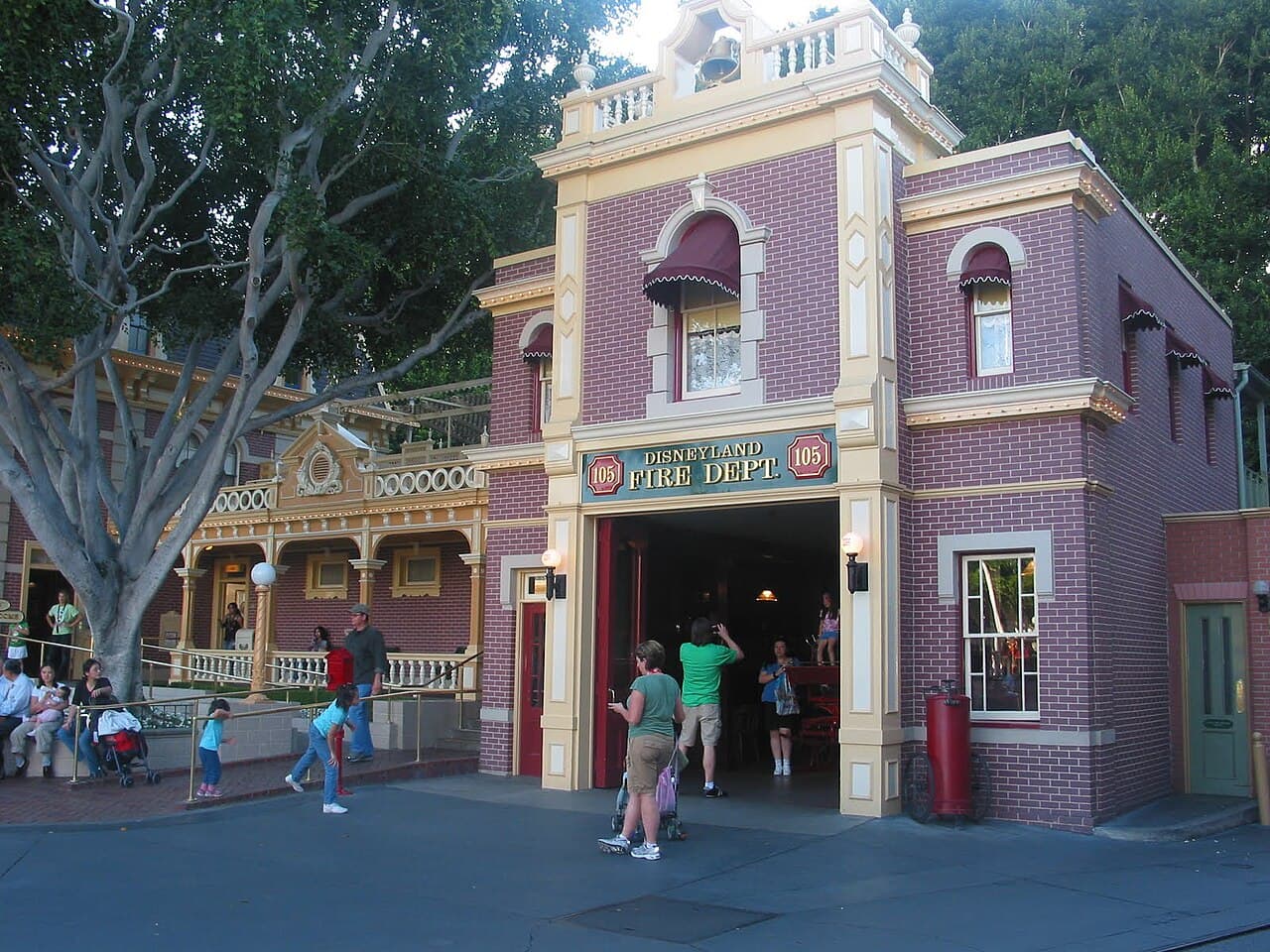
Look at the second floor of the Fire Station building on the left side of Main Street as you enter the park. There is a small lamp glowing in the window. It has been on continuously since 1966.
Walt Disney had a private 500-square-foot apartment built above the Fire Station during Disneyland's construction because he wanted to be physically present on-site as the park was being built. He lived and worked from this apartment during the final years of construction and the early years of operation. When Walt was in residence, he would light the lamp in the window so employees throughout the park would know he was there.
After Walt passed away in December 1966, Disneyland kept the lamp on permanently. It has not been turned off since — with the exception of brief moments by his daughters as personal tributes. The lamp represents Walt's permanent presence in the park he built.
The apartment itself is not open to regular park admission. It can be visited through the Walt's Main Street Story Tour at $160 per person — a guided experience that includes a walk down Main Street and access to the apartment interior, where Walt's original furnishings and personal items remain intact.
Mateo's Take: Every time I walk through those gates I look up at that lamp. It is the single most quietly meaningful detail in the entire park. Most guests have no idea it is there. Now you do. Look for it the moment you enter.
The Griffith Park Bench
Inside the Opera House on Main Street, there is a wooden bench on display that looks unremarkable at first glance. It is one of the most significant objects in all of Disneyland.
This is the actual bench from Griffith Park in Los Angeles where Walt Disney sat watching his daughters ride the merry-go-round and first conceived of the idea for Disneyland. The story goes that while his daughters rode the carousel and he sat on an uncomfortable park bench eating peanuts and watching from the sidelines, Walt began imagining a place where parents and children could enjoy the experience together rather than separately. That idea became Disneyland.
The bench is a permanent exhibit inside the Opera House. It sits in plain sight and almost every guest who passes it has no idea what it is.
The Dream Suite Above Pirates of the Caribbean
Walt Disney designed a second personal apartment to be built above the Pirates of the Caribbean attraction in New Orleans Square — larger than the Fire Station apartment and intended for entertaining VIP guests and his family. He brought in Dorothea Redmond, the set designer famous for creating the sets in Gone with the Wind, to design the interior.
Walt never saw the suite completed. He passed away in 1966 before construction finished.
The space was used for various purposes over the decades and eventually became the Disneyland Dream Suite — a private overnight accommodation available by special invitation or contest win only. It cannot be booked through standard channels. The suite features projected stars and clouds on the bedroom ceiling, a bathroom with a Fantasia music panel, and a parlor based on Walt's original design sketches.
The entrance to the Dream Suite is hidden in plain sight in New Orleans Square — an unmarked door near the corner of Club 33. Almost no guest who walks past it has any idea what is behind it.
Walt's Window on Main Street
Every window on the second floor of Main Street U.S.A. carries a name and a fake business description. These are not random — each window is a tribute to a specific person who made a significant contribution to Disneyland's creation and history. Imagineers, construction crews, executives, and artists are all honored.
Walt Disney's own window is above the main entrance to the park on Town Square — "Walter E. Disney, Founder and Director Emeritus, Enterprises and Visions." It faces inward toward the park rather than outward toward the entrance, because Walt always said he wanted to look into his park, not away from it.
Find the names on the windows as you walk down Main Street and look each one up. They are a complete record of the people who built Disneyland.
The Trash Can Placement Formula
Walt Disney famously conducted a precise study of how far a person walks before discarding trash — timing himself eating a hot dog at a previous theme park and measuring the distance to the nearest can. His conclusion was approximately 30 steps. Every trash can in Disneyland is placed within 30 steps of every other trash can throughout the park.
This is not a myth. It is documented in the original Imagineering design notes. The result is a park that remains visibly cleaner than virtually every other theme park in the world without requiring an army of street sweepers — because the psychology of proximity does the work.
Part 2 — Architectural Secrets and Illusions
Forced Perspective — The Entire Park Is Taller Than It Is
Nothing in Disneyland is the size it appears to be. Walt Disney borrowed forced perspective from film production — the technique of making backgrounds appear farther away by making them progressively smaller — and applied it to the entire park.
Sleeping Beauty Castle is the most famous example. The castle appears to be approximately 77 feet tall. It actually stands 77 feet, but every floor above the ground level is built at a smaller scale than the one below it. The upper windows are roughly two-thirds the size of the ground floor windows. The spires above those windows are even smaller. The result is a castle that reads as far taller and more dramatic than its actual height.
Main Street U.S.A. uses the same technique. The ground floors are built at roughly nine-tenths scale. The second floors at seven-eighths scale. The third floors at smaller still. Combined with the slight uphill grade of Main Street — which creates the sensation that the castle is farther away than it is — the effect makes the approach to Sleeping Beauty Castle feel like a cinematic reveal rather than a simple walk down a street.
The Matterhorn uses forced perspective to appear 147 feet tall while its actual summit tops out at the same 147 feet — but with the upper sections built at progressively reduced scale so the mountain reads as dramatically more massive than the base suggests.
Mateo's Take: Once you know about forced perspective at Disneyland you will see it everywhere. Look at the castle from the Hub and then look at the window proportions from bottom to top. You can see the scaling difference with your naked eye once you know what to look for.
Main Street Is Built on a Slight Uphill Grade
Main Street U.S.A. is not flat. Walk it slowly and you will notice that the street rises gently from Town Square at the entrance to the Hub in front of the castle. This grade was intentional — it increases the sense of journey and destination as guests approach the castle.
On the return trip toward the park exit at the end of the day, the downhill grade provides a subtle psychological ease. Leaving feels slightly easier than arriving. This is not accidental. Walt Disney thought about the emotional arc of the entire day, including the exit.
The Smellitzers — Why Disneyland Smells the Way It Does
Disneyland pumps deliberate scents at strategic locations throughout the park using devices called Smellitzers — scent diffusion machines that release precisely calibrated aromas at timed intervals.
Vanilla and fresh-baked goods on Main Street, particularly near the bakery and candy shop. Salt water and humidity near the entry to Pirates of the Caribbean. Tropical flowers and jungle vegetation in Adventureland. Orange blossom near certain areas of Fantasyland.
These are not ambient scents from actual bakeries or actual flowers. They are engineered atmospheric tools. Walt believed that engaging all five senses simultaneously was essential to creating a genuinely immersive experience — and he was right. The smell of Disneyland is one of the most powerful memory triggers associated with the park for returning guests.
Mateo's Take: Walk slowly past the bakery on Main Street in the morning and consciously register the vanilla scent. Then walk into Adventureland and notice the change. The olfactory design of Disneyland is one of the most underappreciated achievements in the entire park.
The Test Brick Wall Near the Lockers
Near the locker area on Main Street U.S.A., there is a section of red brick wall where the individual bricks are noticeably irregular — slightly different in shape, size, and finish from each other.
This is not a mistake. This wall is made of test bricks from the original construction of Disneyland in 1954 and 1955 — samples that Imagineers used to test different production techniques, textures, and kiln temperatures while developing the final specifications for the park. The irregularity between bricks reflects the experimental nature of the testing process.
Nobody ever removed the wall because it was cheaper to keep it than replace it. It has been standing quietly next to the lockers since opening day 1955 and almost every guest who passes it assumes it is simply old or worn.
The Opera House Was the Original Lumber Mill
The Opera House building on Town Square on Main Street is one of the oldest structures in Disneyland — but not because it was designed as a performance space first. The building was constructed during the park's original build-out to function as the lumber mill where wood was cut and processed for construction throughout the site.
When the park opened in 1955, the lumber mill was repurposed as the Opera House. The building's large size and industrial proportions reflect its original function. It now houses the Lincoln animatronic theater and the Griffith Park bench exhibit.
Part 3 — Hidden Mickeys — The Complete Location Guide
Hidden Mickeys are the unofficial sport of Disneyland fandom. The rules are simple: find the classic three-circle silhouette of Mickey's head — a large circle representing the head with two smaller circles touching at the top representing the ears — hidden deliberately within the design of rides, queues, restaurants, and buildings throughout the park.
The tradition began in the late 1970s when Imagineers started hiding Mickey shapes in EPCOT's designs as an inside joke. It spread to every park. There are now estimated to be over 450 confirmed Hidden Mickeys at the Disneyland Resort alone.
The rule: a true Hidden Mickey requires the classic three-circle configuration. Two circles that vaguely suggest Mickey's shape do not count. The proportions must be reasonably consistent with the classic silhouette. If you have to convince yourself it is there, it probably is not.
Main Street U.S.A.
Market House Party Line Phones: On the wall of Market House on Main Street, there are old-fashioned telephone party line phones. Pick one up and listen — you can hear a recorded conversation between neighbors gossiping and chatting about park events. It is the most interactive hidden detail on Main Street and almost no one stops to use it.
Mickey Survey Marks: Embedded in the streets of Main Street are custom Disney survey marks — the kind surveyors use to mark coordinates for measurements. Each one is shaped and decorated as a themed Disney plaque rather than a standard marker. They are functional survey instruments disguised as park decorations. Look at the pavement as you walk.
Fantasyland Weathervanes: Look up at the rooftops of the Fantasyland dark ride buildings. Each weathervane represents the attraction beneath it. A whale for Pinocchio's Daring Journey. A crown for King Arthur Carrousel. A pirate ship for Peter Pan's Flight. Mr. Toad himself for Mr. Toad's Wild Ride. They are in plain sight on the rooftops and almost no guest looks up to see them.
Adventureland
The Indiana Jones Rope — Pull It
In the Indiana Jones Adventure queue, approximately midway through the line, there is a rope hanging from the ceiling with a sign that says something to the effect of "Do Not Pull." Pull it. An enormous sound effect plays — a rumbling crash from somewhere above the queue — followed by a comical aftermath. The rope has been in the queue since 1995 and triggers a fresh reaction from every new guest who discovers it.
Most guests in line see the rope and the sign and assume it is decoration. It is not decoration. Pull the rope.
The Indiana Jones Projector Room Shadow Mickey
In the projector room section of the Indiana Jones queue — the room with the film equipment and projected footage — look at the right side wall facing Indy's office. There is a large, subtle shadow that forms Mickey's head. It is created by the ambient light in the room falling across a specific piece of equipment. The queue often moves quickly through this section so look for it immediately when you enter the room.
The Jade Elephant
Look at the rooftop of the Tropical Imports stand near the entrance to Jungle Cruise in Adventureland. Sitting on the roof is a jade-colored elephant figurine. It has been there for decades and is consistently overlooked because guests are focused on the path ahead rather than the rooflines above.
New Orleans Square
The 1764 Crypt
On the banks of the Rivers of America in New Orleans Square, partially obscured by the landscaping between Pirates of the Caribbean and the Haunted Mansion, there is a sealed stone crypt bearing the date 1764. It is not part of either attraction. Its origin and purpose have never been officially confirmed by Disney, creating decades of fan speculation — theories range from a planned underground tunnel entrance to a tribute to New Orleans history to an original Imagineering concept that was never completed.
Find the crypt along the waterfront path. It is easy to miss because it blends into the New Orleans Square architecture, but once you know it is there it is impossible to walk past without stopping.
Hidden Mickey in Pirates of the Caribbean — The Barrels
During the Pirates of the Caribbean ride, as the boats float through the treasure room scenes near the end, look up at the ceiling. Three barrels hanging from the rafters form a classic Hidden Mickey silhouette — two smaller barrels touching the top of a larger central barrel. It appears briefly and the boat moves continuously, so look for it the moment you enter the treasure room section.
In the queue for Pirates, look for a crate silhouette along the walls that also forms a subtle Mickey shape.
Hidden Mickey in the Haunted Mansion — The Ballroom Plates
The Haunted Mansion ballroom scene — the famous large room viewed from the Doom Buggies through an impossibly wide window — contains one of the most beloved Hidden Mickeys in the park. On the dining table set for the ghostly feast, look for three plates arranged in the classic Mickey configuration. The plates are present throughout the scene but the dome buggy moves at a steady pace so you need to know where to look. Focus on the center-left section of the dining table as you pass over it.
Also in the Haunted Mansion: immediately after exiting the stretching room, examine the wallpaper in the lower corridor gallery. Hidden within the swirling pattern are several classic Mickey silhouettes embedded in the design. Slow down in this corridor and look at the wallpaper carefully.
The Haunted Mansion Pet Cemetery
On the side of the Haunted Mansion building, before you enter through the main gate, there is a small pet cemetery with elaborate headstones for beloved fictional animals including a cat, a bird, and other pets. The headstones have names, birth and death dates, and epitaphs. It is not part of the formal queue path — it sits off to the side of the building exterior and requires specifically walking around the building to find it.
Most guests enter the Haunted Mansion through the main gate without walking the perimeter. Walk around the left side of the building before entering and find the pet cemetery. It is genuinely funny and genuinely Haunted Mansion in spirit.
Fantasyland
Peter Pan and Wendy's Initials
Near the wishing well at Snow White's Grotto — the small courtyard between the Fantasyland dark rides — there is a slender tree near the staircase leading up toward the castle. Carved into the bark of this tree are the initials "PP" and "WD" — Peter Pan and Wendy Darling. They have been there since the park's early years and are clearly visible once you know which tree to look at.
Hidden Mickey in it's a small world
In the Africa section of it's a small world, look at the purple leaves on the flora and vegetation. Arranged within the leaf pattern are classic Mickey shapes. In the India section, look at the floor tile patterns as your boat moves through — several tiles form subtle Mickey configurations. The ride's continuous movement and visual saturation make these easy to miss, but the Africa purple leaves in particular are large enough to find on a focused look.
Hidden Mickey in Many Adventures of Winnie the Pooh
In the honey-harvesting sections of the Many Adventures of Winnie the Pooh ride, look at the honey bubbles floating through the scenes. Several bubbles are arranged in the classic three-circle Mickey configuration. The honey environment of the ride makes the circles blend naturally — exactly the kind of hidden context Imagineers love.
The Storybook Land Lighthouse
The miniature lighthouse visible in Storybook Land Canal Boats is made from one of the original ticket booths used during the early years of Disneyland — when guests purchased individual tickets for each attraction rather than paying a single admission. The lettering and mechanical details of the ticket booth are incorporated into the lighthouse structure.
This is the last surviving remnant of the original A through E ticket system visible in the park. Guests who ride Storybook Land Canal Boats and do not know this see a lighthouse. Guests who do know this are looking at 1955 Disneyland ticket infrastructure.
Tomorrowland
Hidden Mickey on Big Thunder Mountain — The Gears
Get Our Free Disneyland Trip Planner
Save on Disneyland tickets
Compare prices across Undercover Tourist, Klook, and GetYourGuide
In the outdoor queue area for Big Thunder Mountain Railroad, look at the large industrial gears mounted on the mine equipment props throughout the queue. Three gears of different sizes arranged together form a classic Mickey silhouette. The gear arrangement appears several times throughout the queue in different configurations.
Hidden Mickey in the Indiana Jones Queue — The Bugs
Throughout the Indiana Jones Adventure queue, the stone walls are covered with hieroglyphic-style carvings. Hidden within these carvings are Mickey shapes worked into the pattern — sometimes as three circles, sometimes as a more abstract silhouette. Walk slowly through the queue on a day when the line is short and look at every carved panel rather than looking ahead at the crowd.
Galaxy's Edge
The Functioning Millennium Falcon
The Millennium Falcon prop in Galaxy's Edge is not just a facade. The exterior is a detailed replica with functional mechanical elements — panels that can be opened, equipment bays with actual interiors, and weathering applied to make every section feel used and battle-scarred. The cast members who play mechanics in the land interact with the Falcon as though they are actively repairing it.
Walk around the full exterior of the Millennium Falcon at least once during your visit and look at the details from every angle. The scale of the ship only becomes apparent from certain vantage points, and the weathering detail on the lower hull section is extraordinary.
The In-Universe Rules of Galaxy's Edge
Galaxy's Edge operates on a completely in-universe set of rules. Cast members in the land do not break character under any circumstances. They are citizens of the planet Batuu, not Disney employees. They use in-world language — "first order" refers to the First Order faction in the story, "the Resistance" refers to the other faction. They do not acknowledge the existence of other Disney properties, other theme parks, or anything outside the Batuu narrative.
If you ask a cast member a question using out-of-universe language, they will answer in character. Ask them where the nearest trash can is and they will tell you where to find it in Batuu terms. This is consistent and maintained at all times. Engage with it rather than breaking it — the immersion is the experience.
Part 4 — Secret Spaces
Club 33 — The Most Exclusive Restaurant in Disneyland
Club 33 is a private members-only club located at 33 Royal Street in New Orleans Square. The entrance is a nondescript door with a discreet ornate address marker — 33 Royal Street — set into the ironwork. The door is indistinguishable from the surrounding storefronts to guests who do not know what they are looking for.
Club 33 is the only location in Disneyland Park where alcohol is served to non-cast-member guests. It opened in 1967 as a private dining club for corporate sponsors and VIP guests and has operated as an exclusive membership club ever since. Membership costs are not publicly disclosed but are believed to run into tens of thousands of dollars annually with a significant waiting list.
The interior features original Walt Disney memorabilia, a trophy room with items from Walt's personal collection, and dining that bears no resemblance to standard Disneyland food. The famous phone booth in the entrance vestibule was originally designed to connect directly to Walt's apartment.
Walking past the door at 33 Royal Street and knowing what is behind it is one of the most interesting micro-experiences in all of New Orleans Square.
The Matterhorn Basketball Court
Inside the Matterhorn mountain, in the upper section of the ride structure where only cast members can access, there is a functioning basketball half-court complete with a hoop, backboard, and floor markings. It is not a regulation court — it is a compact break area that Walt Disney had installed when the Matterhorn's internal climber cast members requested a place to play during breaks on inclement weather days.
The bobsled tracks only use the lower 80 feet of the 147-foot mountain. The upper 67 feet is internal cast member space — and somewhere in that space there is a basketball hoop that has been there since approximately 1961.
You cannot see it from the ride. You will never see it unless you are a cast member assigned to the Matterhorn. But it is there, and knowing it is there makes every ride through the mountain different.
Mateo's Take: The Matterhorn basketball court is my favorite secret in all of Disneyland for one specific reason. It is completely invisible to guests, serves no storytelling function whatsoever, and exists purely because Walt Disney asked a crew of mountain climbers what they wanted inside their workplace and built it for them. That is Walt Disney as a person in one anecdote.
The Haunted Mansion's 999 Happy Haunts — And the 1,000th
The Ghost Host famously announces at the beginning of the Haunted Mansion that the mansion is home to 999 happy haunts but there is room for one more. The implication being that you, the rider, might become the 1,000th.
The 999 count is often taken as a narrative device only. It is also backed up in the attraction design — the Imagineers who worked on the Haunted Mansion claim that they specifically designed and counted 999 distinct ghost effects throughout the attraction. Whether this is exactly accurate after decades of updates and seasonal overlays is debated, but the intent was always to match the narrative claim with a literal commitment.
The Haunted Mansion Ashes — The Hazmat Reality
This is the secret that some guests find darkly funny and others find genuinely strange. The Haunted Mansion is one of the most popular locations in the world for families to scatter the cremated remains of loved ones.
Disney does not permit this. Despite the prohibition, it happens regularly enough that Disney maintains a standing protocol — when remains are detected in the attraction, a hazmat team is dispatched to clean the area. The team uses specialized vacuums and the attraction is temporarily closed for the cleaning. Regular cleaning staff are not equipped to handle the situation.
The reason the Haunted Mansion is chosen above all other locations is obvious to anyone who has ever loved the attraction. It is a place where people believe those who have died are still present and still happy. For fans of the ride, it is a form of tribute.
Part 5 — Queue Secrets and Ride Details Most Guests Miss
The Indiana Jones Queue Is a Full Experience
The Indiana Jones Adventure queue is the most elaborately designed pre-ride environment in Disneyland Park and most guests walk through it focused entirely on getting to the ride. The queue contains functioning mechanical artifacts, hieroglyphic carvings with hidden messages, a working fountain that responds to hidden activators, and a full archaeology camp narrative that tells the story of the expedition before the ride vehicle ever begins moving.
Specific things to find:
- The rope to pull (described above)
- The hieroglyphic carvings — some are actual ancient Egyptian motifs, some are invented Imagineering script, and some contain Mickey shapes
- The film projector in the screening room — it is playing actual footage on a loop
- The pile of hats and equipment near the entry that belonged to previous expedition members who did not return
- The recording in the screening room — listen to the full narration rather than letting it run in the background
- The bamboo section where specific stalks, if pressed, produce sounds from somewhere in the queue
Mateo's Take: The Indiana Jones queue deserves 15 minutes on a day when the standby line is short. I have been on this ride hundreds of times and I still notice new things in the queue on every visit. The Imagineering team built an entire story in there that most guests experience as a hallway.
The Pirates of the Caribbean Bayou Scene
The opening bayou scene of Pirates of the Caribbean — the slow drift through the moonlit Louisiana swamp before the drops — is one of the most precisely engineered atmospheric experiences in any theme park. The fireflies are working light effects on cables. The smells are Smellitzers generating specific swamp and bayou scent compounds. The sounds — frogs, crickets, distant music — are layered audio tracks mixed to feel like genuine outdoor soundscape rather than speakers in a building.
The entire bayou is indoors. There is no outdoor sky, no actual water, no real insects. The illusion is so complete that guests who are not thinking about it actively believe they are outside.
Walt Disney considered this scene one of the most successful atmospheric achievements of his career.
The Haunted Mansion Stretching Room
The famous stretching room at the beginning of the Haunted Mansion is not just a room that stretches. At Disneyland specifically — unlike the Walt Disney World version — the floor of the stretching room actually descends. You are not watching the walls go up. You are in an elevator that takes you below ground level, under the railroad tracks that border the park, to the ride loading area that would otherwise be physically impossible to fit within the park's footprint.
The ceiling paintings that seem to stretch upward as the room "grows" are simply fixed art on the walls. The room is moving downward. By the end of the stretching sequence, you are standing underground.
Most guests stand in the stretching room and look up at the paintings. Almost no one feels the floor move because the descent is engineered to be imperceptible.
The Doom Buggy Mirror Trick — How the Ballroom Ghosts Work
The floating, dancing ghosts in the Haunted Mansion ballroom are not projected onto screens or generated by digital effects. They are physical animatronic figures performing below your Doom Buggy position, reflected upward into the ballroom through a large angled mirror using a theatrical technique called Pepper's Ghost — a reflection trick developed by scientist John Henry Pepper in 1862 and still used in the Haunted Mansion exactly as originally designed.
The ballroom below your ride vehicle contains fully articulated ghost figures dancing, drinking, and performing for an audience of no one. They are reflected into the ballroom scene you see through the angled glass. The figures never stop performing regardless of park hours.
The Mark Twain's Smokestacks
When standing at the boarding dock for the Mark Twain Riverboat in New Orleans Square, look up at the two black smokestacks rising from the vessel. Between them is a small decorative metalwork ornament. Look at it carefully — it incorporates two sideways Mickey Mouse head silhouettes worked into the metal scrollwork design.
This one requires some distance to see properly. Step back from the dock and look at the ornament from the approach path rather than from directly alongside the boat.
Part 6 — Cast Member Secrets
The Return Pass
If a ride breaks down while you are in the queue or while you are waiting for a Lightning Lane return window, speak with the cast member at the exit or at the front of the queue and request a return pass. Cast members are authorized to issue these for guests who experienced a breakdown during their wait.
A return pass allows you to re-queue for the attraction on the Lightning Lane side at any point during the same day. This is not a compensation ticket for a long wait — it is specifically for operational breakdowns. But it is real, freely given, and most guests who experience a breakdown simply leave without asking.
The Birthday and Milestone Buttons
City Hall at the left side of Main Street issues free commemorative buttons for any personal milestone you mention — birthdays, anniversaries, first visits, engagements, graduations, and more. The buttons are made by the cast members at the window with whatever text you request.
What most guests do not know is how the buttons function throughout the day. Cast members park-wide are trained to notice and acknowledge the buttons. Characters at meet-and-greets will react specifically to your milestone. Performers and roving cast members will stop and congratulate you. At some restaurants, servers will make special note of celebrations at the table.
The buttons are free. The experience they generate is not small. Pick one up for every milestone in your group.
Characters Walk the Lands — Not Just the Meet-and-Greet Lines
Formal character meet-and-greet lines at Disneyland can run 30 to 60 minutes. What fewer guests know is that characters also walk through their themed lands throughout the day — often with minimal or no queue — transitioning between locations or making spontaneous appearances.
Mickey and Minnie walk Main Street in the morning. Star Wars characters walk through Galaxy's Edge on irregular schedules. Princesses sometimes appear in Fantasyland outside of formal meet-and-greet settings. These appearances are less predictable but often produce more genuine interaction because there is no formal line management structure controlling the time.
Check the Disneyland app under Characters for scheduled appearances, but also keep your eyes open as you walk through the lands.
The Balloon Replacement Policy
If your balloon pops or deflates while you are still inside Disneyland — before you exit the park — return to any balloon cart and show the deflated balloon to the cast member. They will replace it with a new one at no charge.
This policy is not publicly advertised. It exists and has existed for many years. Show the balloon. Get a replacement.
Walt Disney's Apartment Tour
The Walt's Main Street Story Tour at $160 per person is the only way to see the interior of Walt Disney's Fire Station apartment — one of the most historically significant spaces in all of Disneyland.
The tour includes a guided walk down Main Street with a Disney historian, access to the apartment interior with Walt's original furniture and personal items, and refreshments on the apartment patio. It runs approximately 75 minutes and books out significantly in advance.
If Walt Disney history means anything to you as a Disneyland visitor, this tour is worth every dollar. You are standing in the room where Walt lived while building the park. Nothing else at Disneyland compares to that historical weight.
The Hidden Secrets Checklist — Your Discovery List
Use this as your guide on your next visit. Work through as many as you can.
Main Street U.S.A.
- Look up at the Fire Station window — find Walt's lamp
- Find the Griffith Park bench in the Opera House
- Listen to the party line phones at Market House
- Find the test brick wall near the lockers
- Look up at every Main Street window and read the names
- Find Walt's window on Town Square facing inward
Adventureland
- Pull the rope in the Indiana Jones queue
- Find the Mickey shadow in the Indiana Jones projector room
- Find the jade elephant on the Tropical Imports rooftop
- Walk slowly through the Indiana Jones queue and read every carving
New Orleans Square
- Find the 1764 Crypt along the river walk
- Look for three barrels forming Mickey in Pirates of the Caribbean
- Walk around the exterior of the Haunted Mansion before entering — find the pet cemetery
- Look for the Haunted Mansion ballroom plate Mickey
- Find the wallpaper Mickeys in the Haunted Mansion corridor gallery
- Walk past 33 Royal Street and find the Club 33 entrance door
Fantasyland
- Find PP and WD carved into the tree at Snow White's Grotto
- Look up at the Fantasyland rooftop weathervanes
- Find the purple leaf Mickeys in Africa on it's a small world
- Find the lighthouse in Storybook Land made from an original ticket booth
Tomorrowland
- Find the gear Mickeys in the Big Thunder Mountain queue
- Remember: Space Mountain is the one that feels like deep space
Galaxy's Edge
- Walk the full exterior of the Millennium Falcon
- Engage with cast members in-universe — ask them for directions in Batuu terms
- Notice how every surface of Galaxy's Edge is weathered and used-looking
Architecture
- Look at Sleeping Beauty Castle window sizes from bottom to top
- Notice the uphill grade of Main Street as you walk toward the castle
- Register the vanilla scent on Main Street and the swamp scent near Pirates
Queue Details
- Let the Indiana Jones queue audio play — actually listen to the story
- In the Haunted Mansion, feel the floor of the stretching room move
Park Hopper Add-On
Disney California Adventure contains its own layer of hidden secrets — the Lamplight Lounge's secret vault room seating 13 guests, the solar panels behind Radiator Springs Racers that form a giant Mickey when viewed from above, and the Buzz Lightyear Easter egg at Cozy Cone Motel in Cars Land.
See our full DCA Hidden Secrets Guide for the complete California Adventure breakdown.
Guide by Mateo "The Map" Morales | Disneyland Specialist | Theme Park Network
Last updated May 2026. Some details, tour availability, and cast member programs are subject to change. Always verify tour bookings and current programming through the Disneyland app or at Disneyland.com before your visit.
Find hotels near Disneyland
Compare prices across Expedia, Hotels.com, and Booking.com
Ready to plan your trip?
Some links on this page are affiliate links. We may earn a small commission at no extra cost to you. This helps us keep the site free.